From portfolio to capability
his page shows how the research portfolio could be transformed into an organised development program. It connects requirements, modelling, materials, component testing, integration, prototype demonstrations and operational assessment with stakeholder roles, test environments and independent assurance.

The development and validation roadmap contains ten stages:
- Portfolio integration and requirements
- Modelling and digital twin
- Materials and component development
- Component testing
- Subsystem integration
- Integrated stationary article
- Tethered unmanned demonstrator
- Atmospheric test article
- Trans-medium demonstrator
- Operational capability demonstrator
Cross-cutting assurance layers:
- Independent review
- Energy and momentum accounting
- Artefact exclusion
- Safety and ethics
- Data integrity
- Configuration control
Stakeholder groups
- Academic partners
- Government and defence
- Industry partners
- Test facilities
- Independent reviewers
- Investors and strategic partners
Key measurement pillars
- Force and motion
- Field and plasma
- Boundary behaviour
- Energy
- Acoustic and electromagnetic signatures
- Thermal response
Key message: Capability emerges when evidence, systems engineering, facilities, independent review and stakeholder expertise are coordinated across a controlled development program.
Evidence framing
Use the portfolio evidence key:
- Green – peer-reviewed
- Amber – technical and applied
- Red – frontier and exploratory
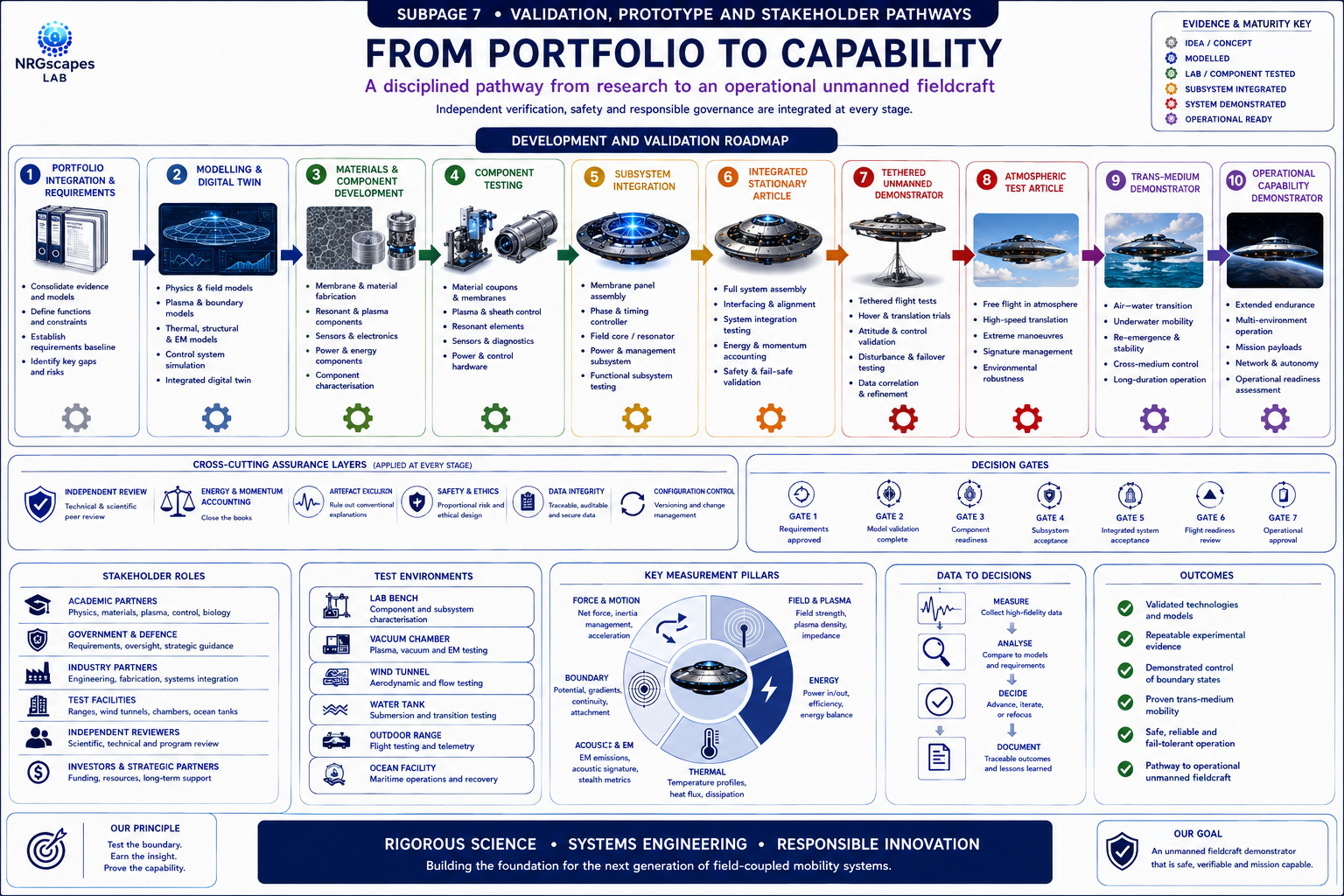
Conceptual engineering synthesis for investigation and stakeholder engagement. The architectures and pathways shown do not represent a demonstrated vehicle or operational capability.