From components to an unmanned trans-medium demonstrator
This page presents the physical experimentation ladder. It begins with individual materials and active membrane panels, progresses through resonant and plasma test rigs, and only advances toward integrated and mobile demonstrators when each preceding evidence gate has been satisfied.

The eight development stages are:
- Material coupons
- Active membrane panels
- Resonant and plasma bench rigs
- Boundary chamber article
- Integrated subscale vehicle
- Tethered unmanned demonstrator
- Free-flight atmospheric demonstration
- Trans-medium demonstrator
Every stage must be:
- Measurable
- Repeatable
- Controllable
- Safe
- Properly energy and momentum accounted
- Independently verified
What this page brings together
- Material testing;
- Dielectric and impedance measurement;
- Phase-delay control;
- Local gating;
- Field closure;
- Resonance stability;
- Plasma attachment;
- Controlled boundary generation;
- Airflow and water interaction;
- Force measurement;
- Telemetry and system health;
- Air–water transition testing.
Key message: The development program advances through evidence, not assumption. Each stage must close alternative explanations before the system moves to greater scale or freedom of operation..
Evidence framing
Use the portfolio evidence key:
- Green – peer-reviewed
- Amber – technical and applied
- Red – frontier and exploratory
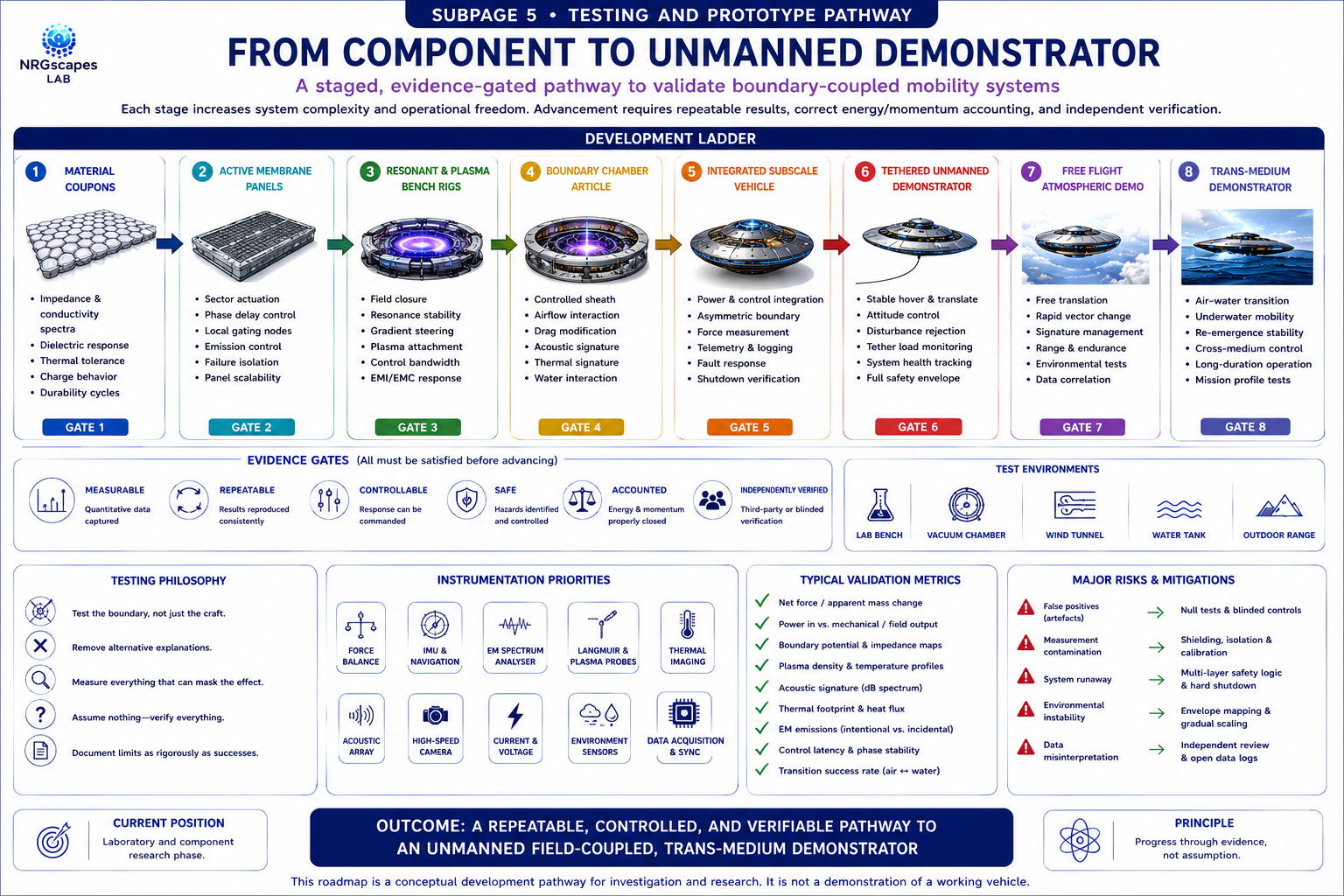
Conceptual engineering synthesis for investigation and stakeholder engagement. The architectures and pathways shown do not represent a demonstrated vehicle or operational capability.