Connecting observations, physical models, materials and control to a complete field-coupled mobility architecture
Two NRGscapes LAB reports provide the main bridge between the wider research portfolio and the engineering program. The first develops the whole-system pathway from UAP observations to an SRMS architecture. The second focuses on the multidisciplinary science and engineering required to create an active craft boundary.
Whole-System Synthesis
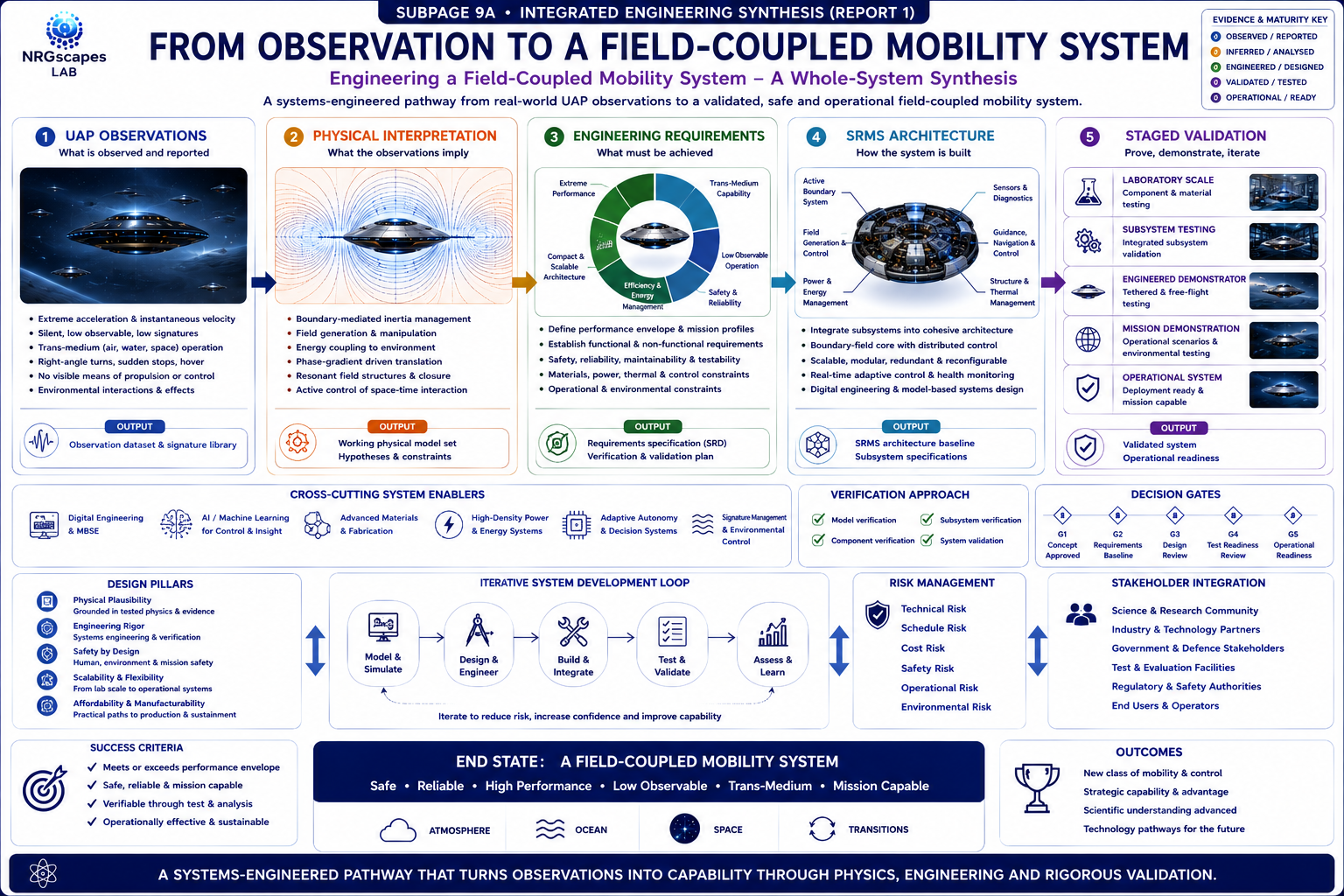
Engineering a Field-Coupled Mobility System
From observation to a field-coupled mobility system. The five main stages are:
- UAP observations
- Physical interpretation
- Engineering requirements
- SRMS architecture
- Staged validation
This synthesis begins with recurring reported behaviours and follows them through physical interpretation, system requirements, architecture and validation. It frames the proposed craft as a complete systems-engineering problem rather than a single propulsion mechanism.
What this diagram brings together
- Observation and signature libraries
- Field and boundary interpretation
- Performance and mission requirements
- Energy and power management
- Adaptive boundary systems
- Guidance, navigation and control
- Sensors and diagnostics
- Structure and thermal management
- Laboratory, subsystem and vehicle testing
Key message
Observational signatures become development inputs only when they can be connected to requirements, subsystem specifications and verification methods.

Active-Boundary Synthesis
Field-Coupled Boundary-Layer Mobility
From physics to an active craft boundary. The six principal stages are:
- Physics foundation
- Chemistry and materials
- Biological analogues
- Distributed control
- Active boundary architecture
- Measurement and laboratory validation
This synthesis focuses on the proposed interaction surface. It combines field physics, adaptive materials, biological design analogues, distributed sensing and actuation, boundary geometry and experimental measurement into one multidisciplinary engineering pathway.
What this diagram brings together
- Field-coupling models
- Toroidal and closed topologies
- Extended electrodynamics;
- Porphyrin and conductive-polymer concepts;
- Dielectric and impedance control;
- Biological sensing and adaptive surfaces;
- Distributed control;
- AI-assisted estimation;
- Active-boundary geometry;
- Drag, signature, stability and transition measurements.
Key message
The active boundary is the point at which physical theory, materials science, biological architecture, control engineering and experimental measurement converge.


Conceptual engineering synthesis for investigation and stakeholder engagement. The architectures and pathways shown do not represent a demonstrated vehicle or operational capability.