From observation to operational capability through a traceable engineering framework
This page provides the portfolio-wide requirements baseline. It connects each observation to a constraint, inferred need, functional requirement, allocated subsystem, evidence status, unresolved gap, next engineering action and verification method.

The traceability chain is:
- Observation Constraint
- Need Requirement
- Component or subsystem
- Test and verification
- Decision gate
The diagram currently maps:
- Extreme acceleration
- Silent and low-observable operation
- Trans-medium mobility
- Hover and station keeping
- Energy efficiency
- Structural resilience
- Autonomy and mission control
- Operational versatility.
What this page brings together
- What is reported or observed
- What must be physically true
- What capability is required
- What the system must do
- Where the function is implemented
- How strong the evidence is
- What remains unknown
- What work happens next
- How the requirement is verified
Evidence maturity levels
- Established or observed
- Strong indication
- Emerging or plausible
- Hypothetical or frontier
- Not demonstrated
Key message: very proposed component must map to a requirement, every requirement must trace back to an observation or mission need, and every gap must have a defined action, owner and decision gate.
Important publication note
The numerical values shown in the diagram – such as totals, percentages, gap counts or active-test counts – should be presented as illustrative dashboard examples unless they are replaced by audited program data.
Evidence framing
Use the portfolio evidence key:
- Green – peer-reviewed
- Amber – technical and applied
- Red – frontier and exploratory
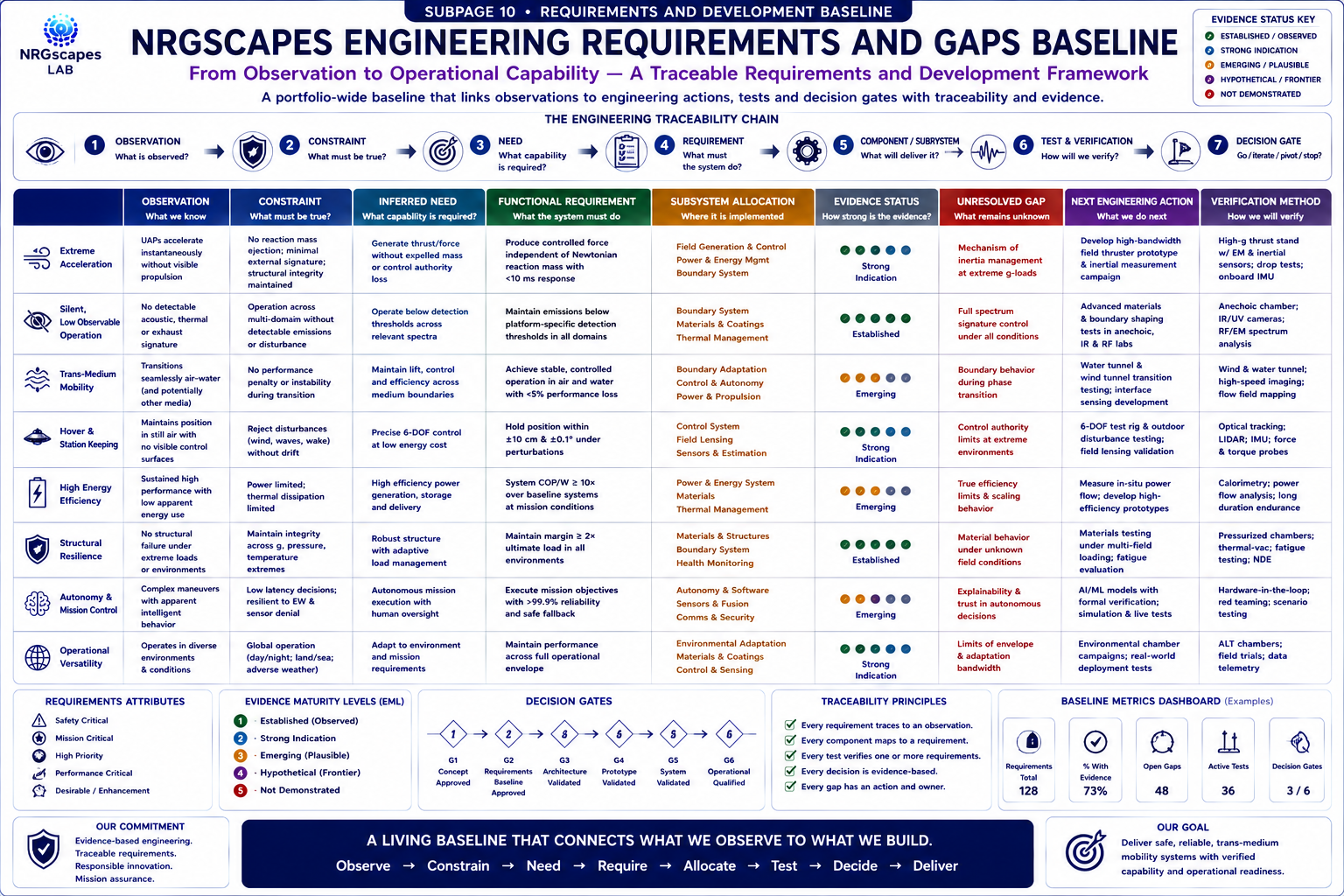
Conceptual engineering synthesis for investigation and stakeholder engagement. The architectures and pathways shown do not represent a demonstrated vehicle or operational capability.